
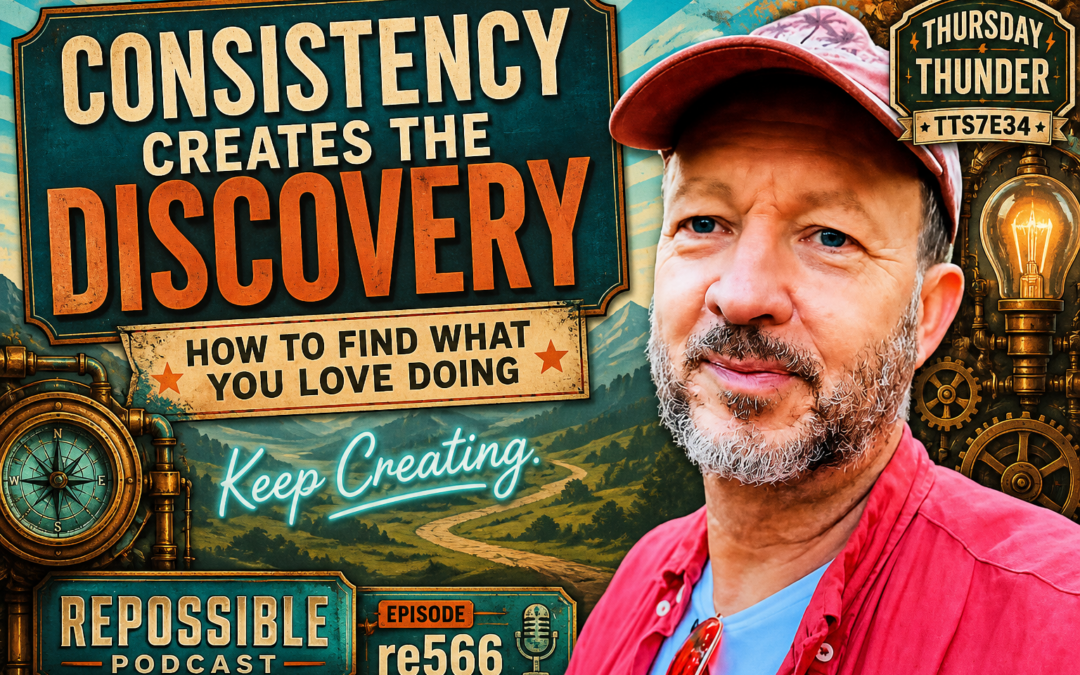
What if you don’t know what you love?
We’re constantly told:
Do what you love.
Great.
But what if you don’t know what that is?
What if you’re still trying to figure it out?
Here’s an idea I’ve been experimenting with for years:
Consistency creates the discovery.
You don’t necessarily find the thing you love and then start doing it.
Sometimes you start doing something—and by doing it again and again, you discover that you love it.
Don’t Be a Writer. Write.
For eight years, I wanted to be a writer.
Or, more accurately, I liked the idea of being a writer.
I thought about writing a book.
I talked about writing a book.
I dreamed about writing a book.
I whined about not writing a book.
There was only one tiny problem:
I wasn’t writing.
Then, on November 1, 2012, a friend challenged me to write every day for 30 days.
No quality requirement.
No word-count requirement.
Just:
Write. Every single day. For 30 days.
So I did.
Something changed.
I stopped trying to be a writer.
I started writing.
That’s a much bigger distinction than it might seem.
A writer writes.
A creator creates.
A runner runs.
A painter paints.
You don’t need the identity first.
Do the thing.
Forget Someday
There’s another problem with waiting until you figure out what you love.
We tend to schedule it for someday.
Someday I’ll write the book.
Someday I’ll learn Italian.
Someday I’ll start painting.
Someday I’ll make the videos.
Someday I’ll try that business idea.
I’ve looked at the calendar.
Someday isn’t on it.
Tuesday is.
Today is.
Right now is.
And right now is the only place where you can actually do anything.
Would You Do It Anyway?
Recently I came across the story of David Senra, creator of the Founders podcast.
He spent years creating his podcast before it became the successful business it is today.
What fascinated me wasn’t the eventual success.
It was why he kept doing it before the success arrived.
He loved doing it.
Senra’s story led me back to Paul Graham’s essay How to Do What You Love.
One of the ideas that struck me was the distinction between loving the idea of something and loving the actual work.
Prestige can fool us.
Money can fool us.
Identity can fool us.
“I want to be a writer” sounds wonderful.
But do you actually like writing?
“I want to be a YouTuber.”
Great.
Do you like making videos?
“I’d love to be an entrepreneur.”
Maybe.
Do you actually enjoy building something?
That’s where the doing becomes useful.
Because doing gives you data.
My 7,000 Experiments
I’ve created more than 7,000 videos.
I’ve written around 40 books.
I’ve recorded hundreds of podcast episodes.
Plenty of them weren’t successful.
Some of my books barely sold.
And yet I kept creating.
Why?
Because somewhere along the way, creating stopped being something I was doing to reach some imaginary destination.
Creating became the thing I loved doing.
That’s the discovery.
And I couldn’t have thought my way into it.
I had to create my way into it.
Consume → Process → Create
I consume constantly.
Books.
Articles.
Audiobooks.
Movies.
Conversations.
Ideas.
Then I process what I’ve consumed.
And eventually I create something from it.
A video.
A book.
A podcast.
A workshop.
An idea like this one.
Consume → Process → Create.
Then repeat.
The repetition matters.
Because one attempt doesn’t tell you much.
Ten attempts tell you more.
Thirty attempts?
Now we’re getting somewhere.
Try It for 30 Days
This is why I love a 30-day experiment.
Not a 30-day transformation.
Not:
CHANGE YOUR ENTIRE LIFE IN 30 DAYS!
Please.
Just an experiment.
Pick something you’re curious about.
Then do a tiny version of it every day for 30 days.
Write.
Draw.
Cook.
Walk.
Photograph.
Record.
Build.
Teach.
Learn.
Create.
Don’t worry yet about whether you’re good at it.
Don’t worry whether anyone will pay you.
Don’t worry whether it becomes your new career, calling, identity or Instagram bio.
Just do the thing.
Then do it tomorrow.
And the next day.
Pay attention to what happens.
You might discover you hate it.
Excellent.
That’s a discovery.
You might discover you can’t stop thinking about it.
Even better.
That’s a discovery, too.
Stop Searching. Start Creating.
We spend an enormous amount of time trying to figure ourselves out.
What should I do?
What am I good at?
What’s my passion?
What’s my purpose?
What will I be next?
Those can be useful questions.
But eventually you have to stop theorizing.
You have to test.
You have to try.
You have to create.
Because maybe clarity doesn’t create consistency.
Maybe it’s the other way around.
Consistency creates clarity.
Consistency creates confidence.
And sometimes—
Consistency creates the discovery.
Keep creating.